 How-to
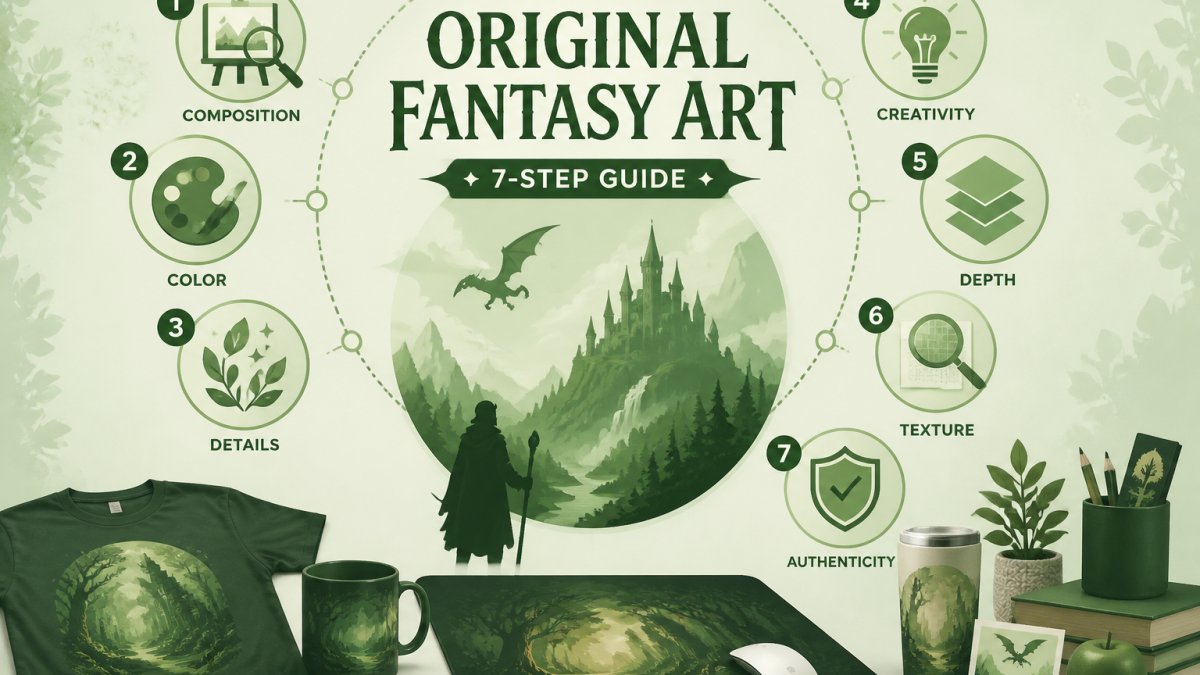
How to Spot Original Fantasy Art: 7-Step Guide
Table of Contents
- What Makes Fantasy Art Original: Beyond the Signature
- Original Artwork vs Print: How to Tell Them Apart
- How to Authenticate Artwork: A Step-by-Step Visual Inspection
- Art Provenance and Certificates of Authenticity: What to Look For
- How to Identify AI-Generated Art: Red Flags and Verification Steps
- Safe Authentication Limits: When to Bring In an Art Specialist
- Conclusion: Buying Original Fantasy Art With Confidence
- Frequently Asked Questions
Last Updated: October 9, 2026
What Makes Fantasy Art Original: Beyond the Signature
Original fantasy art is artwork created by hand as a one-of-a-kind piece, not copied, printed, or generated.
At Mythikal Sundries LLC, we work with fantasy-themed artwork every day, so we know how confusing the market can feel.
Here is the honest truth most guides skip: authenticity comes from the physical object itself, not the paperwork that comes with it. Documents can be faked. Paint layers cannot.
Original Artwork vs Print: How to Tell Them Apart
The fastest way to separate original artwork vs print is to look at the surface at a sharp angle under good light.
Here is what to check:
- Surface depth: Originals show raised paint or brush ridges
- Reflection: Prints often reflect light in a uniform, glassy way
- Edges: Prints may show a thin white border or cut line
- Color: Prints use tiny dots of color, not blended strokes
According to the Smithsonian American Art Museum's guide to caring for artworks, the physical surface of a piece is one of its most telling features for identification.
A common mistake is trusting a low price as proof of a print. Some reproductions sell for high prices, and some originals sell cheap. Price tells you little.
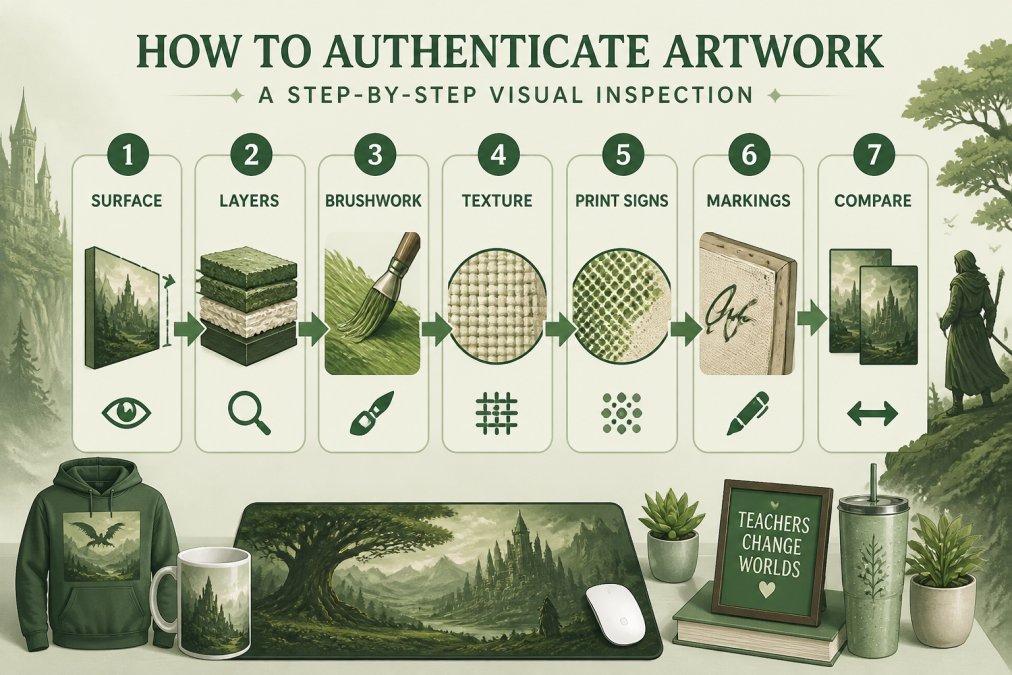
How to Authenticate Artwork: A Step-by-Step Visual Inspection
To authenticate artwork, work through a fixed inspection routine every time. Skipping steps is how buyers get fooled. Follow this order.
Checking Paint Layers, Surface Depth, and Brushwork
Real paint sits in layers. Hold the piece at an angle and look for thickness where strokes overlap. Brushwork should vary: some strokes thin, some thick, some fast, some slow.
Mechanical repetition is the giveaway. If every mark looks identical, suspect a print.
Reading Canvas Weave and Paper Texture
Turn the piece over if you can. Canvas weave should be visible and slightly irregular. Paper texture in a watercolor should feel rough, not slick.
Under a magnifier, a print shows a regular grid of colored dots. An original shows blended pigment with no pattern.
Art Provenance and Certificates of Authenticity: What to Look For
Art provenance and certificates of authenticity matter, but only as supporting evidence. Provenance is the documented ownership history of a piece, who made it, who owned it, and how it changed hands. A certificate is a document from the artist or gallery confirming the work. Neither one replaces a physical inspection.
What Real Provenance Looks Like
Strong provenance is a chain, not a single document. It usually includes some combination of:
- A bill of sale or invoice from the artist or gallery
- Gallery exhibition records or catalog listings
- Auction records with lot numbers and dates
- Insurance appraisals or condition reports
- Correspondence, consignment agreements, or commission contracts
- Photographs of the work in the artist's studio or at an event
For fantasy art, provenance often looks different from fine-art norms. A piece may have been sold at a convention, commissioned directly through an artist's website, or consigned through a specialty gallery.
A common pattern is a gap in the chain: the seller says they bought it from a dealer, but there is no invoice, no name, and no date. Unexplained gaps are not automatically fatal, but they lower confidence and should be priced in.
What a Certificate of Authenticity Should Contain
A certificate is only as good as the information on it. Check these items against the artwork itself:
- Artist name, title, and year match the artwork exactly
- Medium and dimensions match what you can measure
- Edition number (if any) matches the number on the print
- The certificate names a real, contactable source, artist, gallery, or publisher
- The certificate has a signature, stamp, or other mark that can be verified
- The certificate's date is consistent with the work's creation date
A certificate with no verifiable source, no signature, and no matching details is worth little. Treat paperwork as a clue, not proof.
How to Verify Provenance Yourself
You do not need a specialist to do basic verification. Work through these steps:
- Contact the artist or their representing gallery directly and ask whether the piece is in their records.
- Search the artist's official catalog, website, and social profiles for the title and image.
- Check auction databases and gallery archives for prior sales of the same piece.
- Ask the seller for the name and contact information of the previous owner, and follow up.
- Compare the certificate's details against the physical piece, title, year, medium, dimensions, edition number.
If the seller resists any of these steps, that resistance is itself information.
When Provenance Review Is Not Enough
Provenance review tells you where a piece has been, not whether it is genuine. If the price is high, the chain has gaps, or the materials look unusual for the artist, bring in a qualified specialist. A conservator can examine materials and technique; a specialist in the artist's market can compare the work against known pieces. That costs money, but it protects a larger investment.
How to Identify AI-Generated Art: Red Flags and Verification Steps
To identify AI-generated art, look for strange details that no human would paint. AI images often break down in small areas where the model had no consistent rule to follow.
Watch for these red flags:
- Hands with too many or fused fingers, or wrists that bend the wrong way
- Jewelry, straps, or armor that melts into skin or hair
- Background patterns that repeat with slight, unnatural drift
- Text, runes, or sigils that look like writing but resolve into nothing
- Lighting that shifts direction between foreground and background
- Symmetrical faces that are too perfect, or ears and eyes that do not match
These clues are useful but not conclusive. A skilled digital painter can produce a clean, symmetrical image, and a careless AI generation can sometimes pass a quick glance. Treat the red flags as a reason to slow down, not as proof.
Verifying a Digital Original, Edition, or Artist Proof
Digital art complicates the word "original." A digital original is the artist's source file, the layered working document, not a flattened export.
For fantasy illustration specifically, ask whether the work is hand-painted, digitally painted, or AI-assisted. All three can be sold, but they are not the same product, and the price and rights differ.
Ask the seller these questions in writing:
- Is this the source file, a limited-edition print, an open edition, or an artist proof?
- How many prints exist in the edition, and what is this piece's number?
- Does the number on the print match the number on the certificate?
- Is the artist proof documented, and how many were made?
- Was any part of the image generated by AI, and if so, which part?
A seller who cannot answer these plainly is a seller to walk away from.
Checking the Artist's Portfolio and Online Listings
Run a reverse image search on the artwork. Upload the file or paste the listing image into a search engine and look at where it appears. A common pattern is an image showing up on many print-on-demand storefronts with no artist credit, a strong sign the seller does not hold the rights.
Then compare the listing against the artist's official portfolio or catalog. Check the artist's own site, their social profiles, and any gallery that represents them. Look for:
- Whether the piece appears in the artist's official catalog at all
- Whether the title, year, and medium match what the seller claims
- Whether the artist sells the same image directly, and at what edition size
- Whether the artist has posted about forgeries or unauthorized reproductions
If the listing uses a different title, a cropped composition, or a color-shifted version of a known piece, treat it as suspect.
Copyright, Licensing, and the Right to Sell
Confirm the seller has the right to sell the work. Under U.S. Copyright Office guidance on derivative works and registration, copying, reselling, or making derivative works from protected artwork without permission can create legal problems for both buyer and seller. Copyright generally belongs to the creator from the moment the work is fixed in a tangible medium, and it can be registered for stronger enforcement.
A few practical points:
- Buying a print does not transfer copyright. The artist usually keeps it.
- A "limited edition" is a marketing term unless the edition size is documented and honored.
- AI-generated images may have unclear or contested copyright status, so a seller's claim of ownership deserves extra scrutiny.
- If the seller cannot name the artist or show a license, assume the rights are not cleared.
Safe Authentication Limits: When to Bring In an Art Specialist
Know your limits. Visual inspection catches most fakes, but not all. Bring in an art specialist when:
- The price is high enough that a mistake would hurt
- The provenance has gaps you cannot explain
- The materials look unusual for the artist
- You suspect a forgery of a known fantasy illustrator
An expert assessment can include material testing and deep research. It costs money, but it protects a bigger investment.
Conclusion: Buying Original Fantasy Art With Confidence
Telling real from fake comes down to patience and a routine. Inspect the surface, check the layers, read the texture, and verify the paperwork. When in doubt, bring in an expert.
At Mythikal Sundries LLC, every design starts as original fantasy artwork, printed onto durable desk mats and drinkware built for daily use. You get detailed, thematic pieces made for tabletop adventurers.
Get started with Mythikal Sundries LLC and bring a touch of real magic to your workspace.
Frequently Asked Questions
How can you tell an original painting from a print or reproduction?
Hold the piece at an angle under bright light. An original painting shows uneven paint layers, visible brushwork, and surface depth that changes with the viewing angle. A print has a flat, uniform surface and often reveals a regular grid of colored dots under magnification. Canvas or paper texture also differs: original canvas weave sits beneath the paint, while a print on canvas shows texture printed on top of the image.
What should a certificate of authenticity for fantasy art include?
A solid certificate names the artist, the title, the medium, dimensions, and the year of creation. It should also state whether the piece is an original, a limited edition, or an artist proof, and include the edition number if applicable. Look for the artist's signature or a gallery stamp, plus contact information you can verify independently. If a seller cannot produce any documentation, treat that as a reason to slow down before buying.
How can you spot AI-generated or copied fantasy art?
AI-generated fantasy art often shows telltale flaws: hands with too many fingers, weapons that bend illogically, armor with inconsistent detailing, or backgrounds that dissolve into meaningless shapes. Text and signatures may appear as garbled marks. Run a reverse image search to check whether the piece appears elsewhere under a different artist's name. If the seller cannot explain their creative process or provide work-in-progress images, that is a red flag.
What should you check before buying fantasy art online?
Ask for high-resolution photos taken at an angle, close-ups of the signature, and images of the back of the canvas or paper. Request provenance details: where the piece came from, who owned it before, and whether a certificate of authenticity exists. Reverse image search the listing photos. Check the seller's return policy and reviews. If the price seems far below what similar original fantasy art sells for, ask why before committing.