 How-to
How to Clean Personalized Mugs Without Ruining the Design
Quick Summary
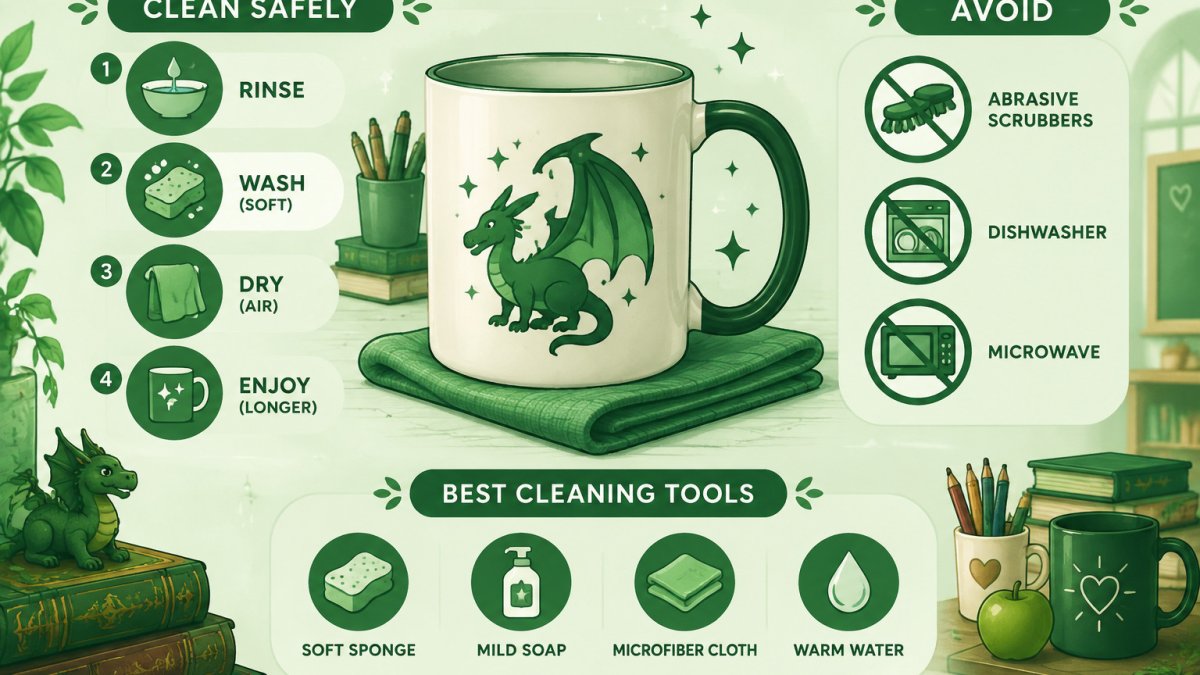
Cleaning personalized mugs safely means using mild dish soap, warm water, and a soft microfiber cloth, while avoiding bleach, abrasive scrubbers, and long soaks that can fade or lift the printed design. Hand washing is the safest method for every personalization technique.
- Mild dish soap and warm water remove everyday residue without harming most printed designs.
- Avoid bleach, steel wool, and abrasive scrubbers, since they can fade colors and scratch the print.
- Never soak a printed mug for long periods, because extended soaking can loosen the print.
- Make a baking soda paste and wipe lightly with a soft cloth to lift coffee and tea stains.
- Vinyl decals are the most vulnerable and should be hand washed only and never microwaved.
Table of Contents
- Why Personalized Mugs Need Different Cleaning
- Safe vs. Unsafe Cleaning Agents for Printed Mugs
- Step-by-Step: How to Sanitize Cups and Mugs
- How to Remove Coffee and Tea Stains Gently
- Are Custom Mugs Dishwasher and Microwave Safe?
- Materials, Coatings and Food-Contact Safety
- Keeping Your Printed Mug Looking New
- Frequently Asked Questions
Why Personalized Mugs Need Different Cleaning
A printed mug looks like any other mug until you start cleaning personalized mugs and scrub it. Then the design can fade, flake, or dull. Many people reach for the strongest cleaner under the sink, and that habit is often what ruins the artwork.
Printed designs can sit on the surface of the mug rather than fused into the glaze, so they may be more exposed to abrasion and harsh chemicals. A sponge with a rough side or a long soak in a strong cleaner can wear down the print over time.
Printed drinkware benefits from different cleaning than plain mugs. For a broader walkthrough of routines beyond sanitizing, see the full care guide for printed drinkware.
Safe vs. Unsafe Cleaning Agents for Printed Mugs
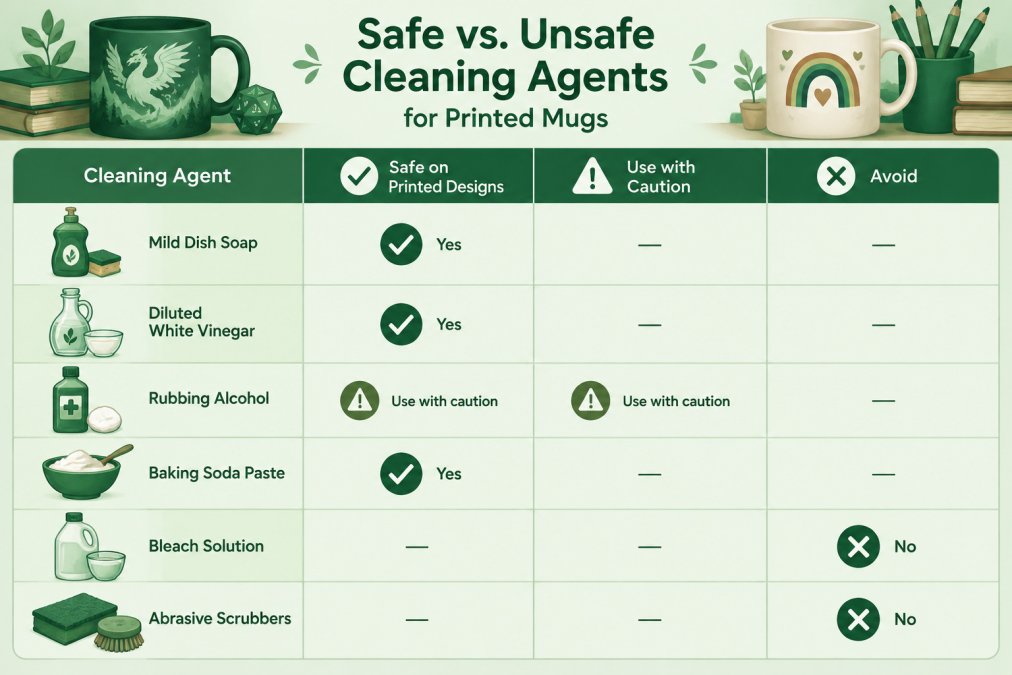
Not every cleaner suits a printed mug. Some products are gentle enough for daily use, while others can strip ink or leave a residue that is unsafe to drink from. Knowing the difference is the fastest way to protect your mugs.
Agents That Are Generally Safe
These options work well for routine cleaning when used in small amounts:
-
Mild dish soap: Gentle on most printed surfaces and easy to rinse away.
-
Warm water: Removes most everyday residue with no chemical risk.
-
Baking soda paste: A soft option for stubborn spots, applied with a cloth rather than a scrubber.
-
Microfiber cloth: Lifts residue without scratching the design.
Agents to Avoid on Printed Designs
These can damage prints or leave residue behind:
- Bleach solutions: Can fade colors and leave a chemical taste or residue.
- Abrasive scrubbers and steel wool: Scratch and wear down the printed surface.
- Strong oven or drain cleaners: Too harsh for any drinkware.
- Concentrated alcohol: Can loosen the print over repeated use.
- Harsh degreasers: Hard to rinse fully, so residue can stay on the rim.
A common mistake is assuming that stronger means cleaner. For printed mugs, gentle and thorough beats harsh every time.
The table below sums up which cleaners suit printed designs and which to avoid.
| Cleaner | Verdict | Why |
|---|---|---|
| Mild dish soap | Safe | Gentle on most printed surfaces |
| Warm water | Safe | Removes everyday residue with no chemical risk |
| Baking soda paste | Safe | Soft option for stubborn spots |
| Microfiber cloth | Safe | Lifts residue without scratching |
| Bleach solutions | Avoid | Can fade colors and leave residue |
| Abrasive scrubbers and steel wool | Avoid | Scratch and wear the printed surface |
| Concentrated alcohol | Avoid | Can loosen the print over repeated use |
| Harsh degreasers | Avoid | Hard to rinse fully, residue can stay on rim |
Step-by-Step: How to Sanitize Cups and Mugs
Sanitizing is different from everyday washing. It reduces germs on the surface. Follow these steps to sanitize without harming the design.
- Wash first. Use warm water and a few drops of mild dish soap. Wipe with a soft cloth.
- Rinse completely. Remove all soap, since leftover soap can affect taste.
- Prepare a light sanitizing solution. Mix a small amount of diluted white vinegar with water. Keep the mix mild.
- Wipe the inside and outside. Use a microfiber cloth and avoid pressing hard on the print.
- Let it sit briefly. Give the solution a short contact time, then rinse.
- Rinse again with clean water. Make sure no vinegar smell remains.
- Air dry or towel dry gently. Pat dry with a soft cloth.
Watch out: Never soak a printed mug for long periods. Extended soaking can loosen the print, even with mild cleaners.
How to Remove Coffee and Tea Stains Gently
Coffee and tea stains build up slowly, and they are easy to remove without harsh chemicals. A little patience works better than scrubbing.
- Make a paste: Combine baking soda with a small amount of water.
- Apply lightly: Spread the paste on the stain with a soft cloth.
- Wipe in gentle circles: Avoid heavy pressure on the printed area.
- Rinse thoroughly: Remove every trace of the paste.
- Repeat if needed: Stains often lift after two or three light passes.
For tea stains, a mild vinegar rinse can help. Keep the contact time short and rinse well afterward.
Are Custom Mugs Dishwasher and Microwave Safe?
Dishwasher and microwave safety depends on two things: the mug body and the personalization technique. If you're unsure about a specific mug, you can contact Mythikal Sundries™ with product-specific questions. A ceramic blank may be dishwasher safe while the print on it is not, so the care label on the finished product, not the blank, is what matters.
How dishwashers damage prints
A dishwasher combines heat (often 140°F to 150°F on the main wash and higher during drying), prolonged moisture, and alkaline detergent. Sublimated prints, which are heat-pressed into a polymer coating, generally tolerate this better than vinyl or decals, but repeated cycles still fade colors and can lift edges. Vinyl decals are the most vulnerable: heat softens the adhesive, and water works under the edges until the design peels. Hand-painted designs and metallic or glitter finishes can dull or flake.
A practical rule: if the design has a visible edge you can feel with a fingernail, treat the mug as hand-wash only. If the print feels flush with the glaze, it is more likely to survive the dishwasher, but top-rack placement and a low-temperature or air-dry cycle reduce risk.
Microwave risks
Microwaves heat unevenly, and printed areas can absorb heat differently from the surrounding glaze. Metallic prints, gold or silver rims, and decals containing metal flakes can arc and spark, which damages both the mug and the microwave. Vinyl decals can soften and shift. If a mug is labeled microwave safe, heat in short intervals and check the print and rim afterward. If the mug has any metallic element or an unknown finish, do not microwave it.
Watch out: Never microwave a mug that has just come out of the refrigerator for an extended time; thermal shock from rapid heating can crack glazed ceramic and glass, especially around a printed area.
A safe way to test an unfamiliar mug
Before trusting a new personalized mug to appliances, test it. Wash it by hand once and inspect the print for lifting or dulling. Run it through a single dishwasher cycle on the top rack with a low-heat or air-dry setting, then compare the print and feel the edges. For microwave safety, place the mug with water in it and heat in 20-second intervals, checking for sparks, unusual heat at the print, or a change in the finish. If anything looks or smells different, switch to hand washing.
Care by personalization technique
- Sublimation: The most appliance-tolerant print; top-rack dishwasher cycles are usually acceptable, but hand washing extends color life.
- Vinyl decals: Hand wash only; avoid soaking and never microwave.
- Decals and transfers: Hand wash with mild soap; avoid the dishwasher and abrupt temperature changes.
- Hand-painted designs: Hand wash gently and avoid both the dishwasher and microwave unless the maker states otherwise.
When in doubt, hand washing with mild dish soap and warm water is safe for every technique, and it is the only method that reliably protects both the print and the drinking surface.
Materials, Coatings and Food-Contact Safety
A mug's material and finish determine which cleaners are safe, how much heat it tolerates, and how easily residue clings to the surface. Treating every mug the same is how people accidentally dull a print or leave a chemical film on a drinking rim.
Ceramic and glazed stoneware
Glazed ceramic is the most forgiving surface for printed drinkware. The glaze is nonporous, so mild dish soap, warm water, and a soft cloth lift most residue. The risk is at the print itself: sublimated and decal designs sit on top of or just below the glaze, and abrasive scrubbers wear them down over time. A non-scratch sponge or microfiber cloth is enough. Avoid sudden temperature swings, such as moving a hot mug straight into cold water, because thermal shock can craze the glaze and create tiny cracks where residue and moisture collect.
Glass
Glass mugs with printed designs behave much like glazed ceramic, but they show water spots and film more readily. You can browse printed drinkware and mugs to see the glass and ceramic styles discussed here. A diluted white vinegar rinse (about one part vinegar to three parts water) cuts mineral film without attacking the print. Rinse thoroughly afterward so no vinegar taste remains. Glass is also more vulnerable to thermal shock than ceramic, so let a hot glass mug cool before washing.
Stainless steel and insulated tumblers
Stainless steel is durable but often carries a powder-coated or painted exterior and a printed logo. The exterior coating is the fragile part: abrasive cleaners and scouring pads can chip it, and prolonged soaking can let moisture work under the coating at seams. Hand wash the exterior with mild soap and a soft cloth, and avoid bleach, which can pit stainless steel over repeated exposure. For insulated tumblers, never submerge the body if the manufacturer warns against it, because water can enter the vacuum layer through seams.
Specialty and coated finishes
These surfaces trap residue in their texture and lose their look when scrubbed. Use a damp microfiber cloth with a drop of mild dish soap, wipe in one direction rather than circles, and rinse with a clean damp cloth instead of running water directly on the finish when possible.
Food-contact safety and residue
The inside of the mug is a drinking surface, so the standard is higher than for the exterior. Rinse every cleaner away completely, including vinegar and baking soda, because residue affects taste and, in the case of soap, can cause stomach upset. Never mix cleaners: combining vinegar and bleach produces chlorine gas, and combining bleach with ammonia-based cleaners produces chloramine vapors. Use one cleaner at a time and rinse between steps. Distinguish cleaning (removing residue and stains) from sanitizing (reducing germs): a thorough soap-and-water wash followed by a clean rinse is sufficient for everyday use, and sanitizing is a separate step for shared or recently ill-household drinkware.
Watch out: A mug that smells of vinegar or soap after drying was not rinsed enough; rewash and rinse with clean water before drinking from it.
Keeping Your Printed Mug Looking New
Good habits help a printed design last for years. Wash by hand when possible, use mild soap, and avoid long soaks. Store mugs away from heavy stacking that could scratch the print.
For personalized gifts, a little care goes a long way. A gentle routine keeps the artwork bright and makes the mug a lasting reminder of the person who received it.
Prevention is the easiest form of cleaning. Rinse mugs soon after use, so stains do not set. Dry them promptly to avoid water spots. With these simple steps, your printed mug can stay as vibrant as the day it arrived.
Cleaning personalized mugs safely comes down to gentle products, careful technique, and thorough rinsing. Follow these steps, and your printed designs will look good for much longer.
Frequently Asked Questions
Can I use vinegar to clean a personalized mug?
Diluted white vinegar is a common option for removing mineral film and light odors from a mug's interior. Mix it with water, rinse thoroughly, and avoid soaking the printed exterior for long periods, since acid and prolonged moisture can dull or lift some designs. After cleaning, rinse the mug with plain water so no vinegar taste or residue remains before the next use.
Are custom mugs dishwasher safe?
Many custom mugs are sold as dishwasher safe, but the printing method determines how well the design holds up. Check the seller's care instructions for your specific mug. Hand washing with mild dish soap and a soft cloth is the safest default for preserving the design over time.
How do I remove coffee and tea stains without damaging a mug's design?
Start with a paste of baking soda and water, applied with a soft cloth and light circular motion on the interior. Avoid scrubbing the printed exterior at all. Skip abrasive pads, which can scratch glaze and wear down printed surfaces.