 how-to
How to Care for Printed Drinkware: 2026 Guide
Table of Contents
- Quick Start: The 3 Rules That Protect Every Print
- Dishwasher Safe vs Hand Wash Only: How to Tell the Difference
- Step-by-Step: How to Hand-Wash Printed Drinkware
- Microwave Safety for Printed Tumblers
- Best Cleaning Tools for Printed Cups
- How to Remove Stubborn Stains Without Damaging the Print
- Material-Specific Care and Eco-Friendly Cleaning for Printed Drinkware
- Common Mistakes That Fade Prints (and How to Avoid Them)
- Frequently Asked Questions
Last Updated: September 28, 2026
Quick Start: The 3 Rules That Protect Every Print
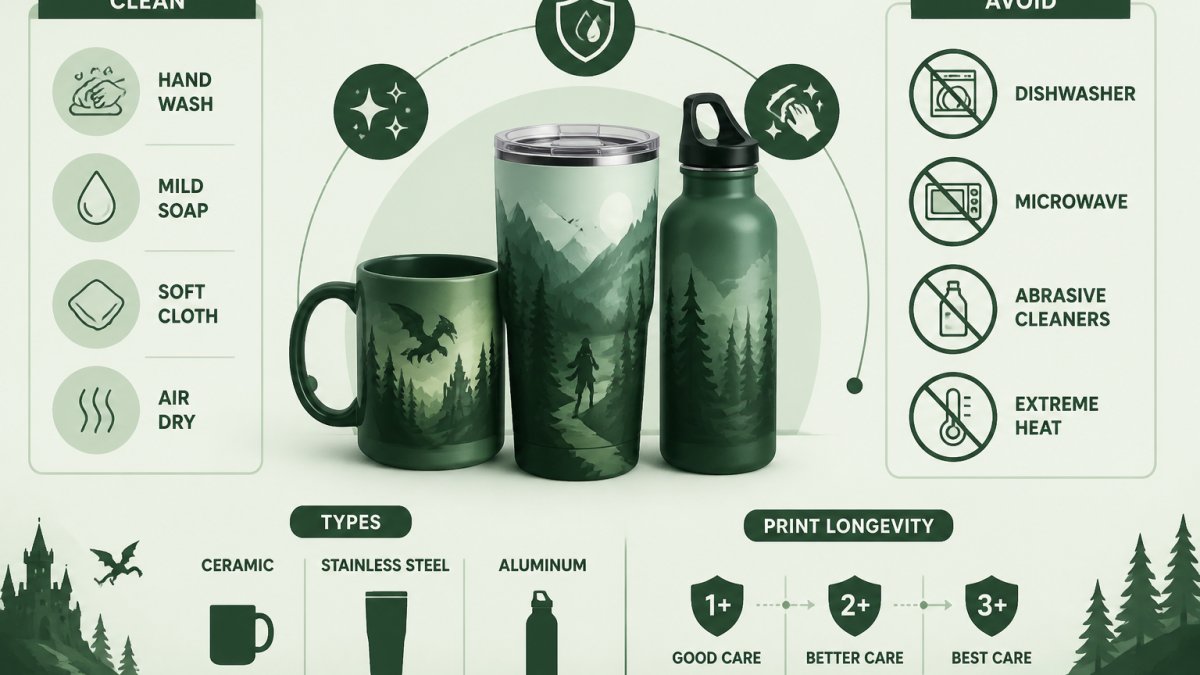
Learning how to care for printed drinkware comes down to three habits: wash gently, dry fully, and skip the heat. The good news is that the fix takes seconds once you know it.
- Hand wash when in doubt. Hot water and harsh detergent wear down the protective coating over time.
- Air-dry upside down. Trapped moisture under a print can lift edges and cloud colors.
- Never microwave a decorated cup unless the label clearly says it's safe.
Follow these and your imprint longevity improves dramatically.
Dishwasher Safe vs Hand Wash Only: How to Tell the Difference
Most printed cups are hand wash only, even when the base material is dishwasher safe. The print, not the cup, is usually the weak point.
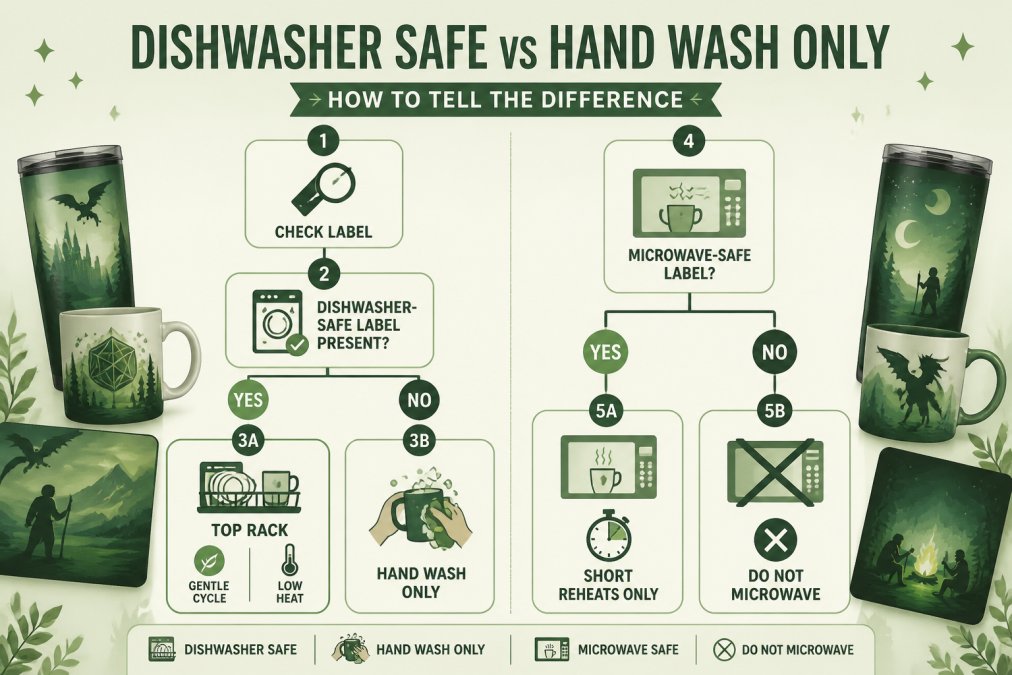
Where to Find the Label on Printed Drinkware
Look on the bottom of the vessel first. Most manufacturers print care icons there, including a dishwasher symbol and a microwave symbol.
Step-by-Step: How to Hand-Wash Printed Drinkware
Hand-washing is the safest method for any decorated cup, and it takes under a minute per item.
- Rinse first. Warm water removes loose residue before it sets.
- Add mild detergent. A drop of dish soap in warm, not hot, water is enough.
- Wipe with a soft sponge. Avoid the abrasive sponge side entirely.
- Skip soaking for long periods. A quick soak is fine; overnight is not.
- Rinse clean. Leftover soap dulls the surface over time.
- Air-dry upside down on a rack with good air circulation.
Cleaning Lids, Straws, and Removable Parts
Lids and straws collect residue in the seams, so they need extra attention. Most are food-grade plastic and can tolerate warmer water than the printed body.
- Soak lids in warm soapy water for a few minutes.
- Use a small bottle brush to reach inside straws.
- Rinse thoroughly and air-dry separately so no moisture stays trapped.
Microwave Safety for Printed Tumblers
Here is the mechanism behind each failure mode:
- Metallic and gold-tone inks arc. Real metallic pigments contain suspended metal particles. In a microwave, those particles act like tiny antennas and can throw sparks, scorch the glaze, or crack the decoration. This is the same reason gold-rimmed dinner plates are labeled "not microwave safe."
- Sublimation prints can re-sublimate. Sublimation dyes are gas-transferred into a polyester coating at roughly 350-400°F during production. A microwave can push a small area of that coating back toward those temperatures, and the dye can migrate or blur. The print does not always vanish, but it softens and loses edge definition.
- Decals and screen prints sit on top of the surface. Their adhesive or clear-coat layer softens with heat, which is when edges lift and colors cloud. Raised decals you can feel with a fingernail are the highest-risk category.
- UV-cured prints are usually the most heat-tolerant, but only when the label says so. UV ink cures hard and bonds tightly, yet the substrate underneath (thin plastic, coated stainless) can still warp or discolor.
Never microwave these:
- Cups with metallic, gold-tone, or foil-look designs
- Any tumbler with a stainless steel body (metal reflects microwaves and can damage the appliance)
- Items with a decal you can feel raised on the surface
- Double-walled or vacuum-insulated drinkware of any kind
When in doubt, transfer the drink to a plain mug. It takes ten seconds and it is the only guaranteed way to protect a print you care about.
Best Cleaning Tools for Printed Cups
The best cleaning tools for printed cups are soft and non-scratch. Scratch resistance varies by print method, but no print survives steel wool.
What to use:
- Soft sponge or microfiber cloth
- Bottle brush for narrow openings
- Mild, non-chlorine dish detergent
What to avoid:
- Abrasive sponges and scouring pads
- Chlorine bleach, which breaks down many coatings
- Powdered cleansers with grit
How to Remove Stubborn Stains Without Damaging the Print
Stubborn stains come off with patience, not force. Start gentle and work up only if needed.
Try these in order:
- Soak in warm water with mild detergent for 10 minutes.
- Wipe with a soft cloth using light pressure.
- For coffee or tea stains, make a paste of baking soda and water.
- Apply the paste to the stain only, not the print, and let it sit briefly.
- Rinse well and air-dry.
Material-Specific Care and Eco-Friendly Cleaning for Printed Drinkware
Most care guides stop at the base material. The print method matters just as much, and pairing the two is what actually extends the life of a decorated cup.
Match the cleaner to the print method
| Print Method | How It Bonds | Safest Cleaner | Avoid |
|---|---|---|---|
| UV print | Cured hard onto the surface | Mild dish soap, warm water | Abrasives, acetone, alcohol wipes |
| Screen print | Thick ink layer cured on top | Mild dish soap, soft sponge | Scouring pads, chlorine bleach |
| Sublimation | Dye fused into a polyester coating | Mild dish soap, baking soda paste | Solvent cleaners, high heat |
| Decal / transfer | Adhesive film on the surface | Warm water, gentle soap | Long soaks, dishwasher cycles |
A few practical rules fall out of that table:
- Never use acetone, nail polish remover, or rubbing alcohol on a UV print. They can cloud the cured surface permanently.
- Skip chlorine bleach on screen prints. It attacks the ink layer and dulls colors over repeated exposure.
- Do not soak decals. Water works its way under the film and lifts the edges.
- Sublimation is the most forgiving of the four, but it still hates heat and solvents.
Match the cleaner to the base material
| Material | Wash Method | Heat Limit | Best Cleaner |
|---|---|---|---|
| Ceramic | Hand wash | Warm water | Mild soap |
| Stainless steel | Hand wash | No microwave | Vinegar solution (brief) |
| Glass | Hand wash or top rack | Moderate | Baking soda paste |
| Plastic | Hand wash | Cool water | Mild detergent |
Eco-friendly cleaning that is also print-safe
Plain white vinegar, baking soda, and castile soap handle most jobs without the harsh surfactants that wear down a protective coating. A few specifics:
- Baking soda paste (three parts baking soda to one part water) lifts coffee and tea stains. Apply to the stain, not the print, and rinse within a few minutes.
- Diluted white vinegar (one part vinegar to three parts water) cuts mineral film and odors. Keep the soak under five minutes, vinegar is acidic and prolonged contact can dull a coating.
- Castile soap diluted in warm water is a gentle everyday wash that leaves no residue.
- Skip "natural" citrus cleaners that list d-limonene or orange oil. Those solvents can soften screen-printed and decal inks even though they are plant-derived.
If the print has already started to fail
This is the part most guides skip. Once a print is peeling or fading, you cannot reverse it, but you can stop the damage from spreading:
- Lifting edges on a decal: stop washing it. Press the edge down with a soft cloth while the cup is dry, and switch to hand-washing only. Do not pick at the lifted corner.
- Cloudy or dull UV print: the clear coat has been scratched. There is no home fix, but switching to a microfiber cloth prevents further abrasion.
- Faded sublimation: the dye has migrated out. Keep the cup out of direct sunlight and hot cars to slow the fade.
- Flaking screen print: the ink layer has lost adhesion. Hand-wash only, and avoid stacking the cup against other drinkware.
Common Mistakes That Fade Prints (and How to Avoid Them)
The biggest mistake is treating a printed cup like a plain one. Small habits add up to visible wear and tear faster than most people expect.
- Using the dishwasher on the heated dry cycle. Heat is the top killer of screen printed and UV print designs.
- Scrubbing with an abrasive sponge. It strips the top layer of the print.
- Soaking overnight. Prolonged soaking softens adhesives on decals.
- Stacking cups tightly. Rim-to-print contact causes scratches.
- Leaving cups in a hot car. Heat plus sunlight fades vibrancy fast.
Frequently Asked Questions
Is it safe to put printed drinkware in the dishwasher?
Only if the item is labeled dishwasher-safe. Even then, place it on the top rack, use a gentle cycle, and choose low heat or air-dry to protect the print. High heat and harsh detergents can break down the protective coating over time, causing colors to fade or peel. If there is no dishwasher-safe label, hand wash with mild detergent and a soft sponge.
How do I prevent the design on my mug from fading?
Hand wash with warm water and mild detergent, avoid abrasive sponges, and skip the dishwasher's heated dry cycle. For dishwasher-safe items, use the top rack and a gentle cycle. Also, avoid soaking for long periods and never use chlorine bleach. These steps preserve imprint longevity and keep UV or screen-printed designs vibrant.
Can I use a microwave for custom printed drinkware?
Check the label first. Only items explicitly marked microwave-safe should go in. Even then, avoid microwaving for long periods or with oily foods, as high heat can damage the print and the material. If there is no microwave-safe label, do not microwave; use a separate bowl or cup for heating.
What is the best way to clean printed glassware without damaging the print?
Hand wash with warm water, a drop of mild dish soap, and a soft sponge or bottle brush. Rinse thoroughly and air-dry upside down on a rack. Avoid abrasive scrubbers, steel wool, and harsh chemicals. For stubborn residue, soak in warm water with a little baking soda for 10-15 minutes, then gently wipe.
Caring for printed drinkware takes less effort than replacing it. At Mythikal Sundries LLC, we craft our fantasy-themed cups and tumblers with original artwork meant to last through daily quests. Our durable drinkware, detailed designs, and custom print options are built for real use, not shelf display. Shop All and find a piece worth protecting.