 blog
blog
Personalized Teacher Stationery: 7 Gift Ideas for 2026
Table of Contents
- Why Personalized Teacher Stationery Makes a Lasting Gift
- Custom Teacher Notepads: Practical Tools for Lesson Reminders
- Teacher Appreciation Gift Ideas: From Thank-You Notes to Desk Accessories
- Personalized Note Cards and Monogrammed Stationery Sets
- DIY vs. Professional Printing: A Cost Analysis for Custom Stationery
- Stationery for Specific Teacher Roles and Eco-Friendly Options
- Frequently Asked Questions
Last Updated: September 27, 2026
Why Personalized Teacher Stationery Makes a Lasting Gift
Personalized teacher stationery turns an everyday tool into something a teacher actually looks forward to using. This guide from Mythikal Sundries LLC covers seven ideas for 2026, from custom notepads to monogrammed note cards, with practical notes on cost, quality, and etiquette. A thoughtful touch matters because teachers write constantly: lesson plans, parent notes, and thank-you cards all flow through the same desk.
Custom Teacher Notepads: Practical Tools for Lesson Reminders
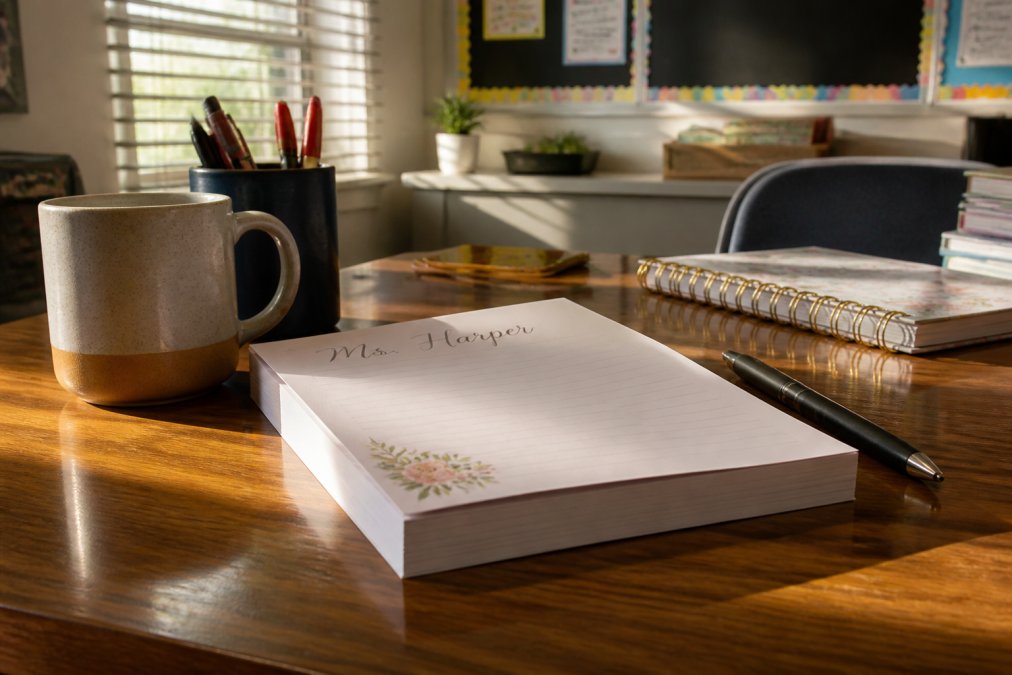
Custom teacher notepads are the workhorse of this category. A pad sized for quick notes, printed with the teacher's name and a light design, sits on the desk and gets grabbed twenty times a day. Unlike a framed print, it earns its place.
What to Put on a Custom Notepad
Keep the layout simple so there's room to write. Most teachers prefer a name or initials at the top, a small illustration in a corner, and plenty of blank space below. A faint margin line helps with lesson reminders and to-do lists.
- Teacher's name or monogram, printed small
- A subject-themed illustration, such as a globe or a stack of books
- A subtle border that doesn't compete with handwriting
Teacher Appreciation Gift Ideas: From Thank-You Notes to Desk Accessories
Teacher appreciation gift ideas work best when they solve a real problem. A set of note cards means the teacher stops buying their own. A desk accessory means the workspace gets calmer. Both beat another scented candle.
Gifts for Back-to-School and End-of-Year
Back-to-school gifts should be functional. A fresh notepad or a planner insert can help a teacher start the year organized. End-of-year gifts can lean sentimental: a note card set the teacher keeps, or a custom journal for summer planning.
- Back-to-school: notepads
- End-of-year: monogrammed note cards, custom journals
| Occasion | Best Gift | Why It Works |
|---|---|---|
| Back-to-school | Custom notepad | Used from day one |
| Appreciation week | Stationery set | Practical and personal |
| End-of-year | Monogrammed note cards | Kept, not consumed |
Personalized Note Cards and Monogrammed Stationery Sets
Personalized note cards carry a teacher's name into every note home, which is why they read as professional rather than fussy. A monogram keeps the design clean and works for any subject or grade level.
DIY vs. Professional Printing: A Cost Analysis for Custom Stationery
Most buying guides discuss the DIY-versus-professional question. The 'personalized stationery is pricey' complaint is a common objection, and the answer depends almost entirely on how many units you need and whether your design has fine detail.
The Real Cost Stack for DIY
Home printing is not free. Every set you produce pulls from four buckets:
- Ink or toner. A full-color note card with a border and a name eats a meaningful share of a cartridge. At typical home-printer yields, a 25-card run can consume a noticeable fraction of a standard color cartridge, which is why DIY gets expensive fast on anything with heavy ink coverage.
- Card stock. Quality 80 lb. to 110 lb. cover stock runs higher per sheet than the copy paper most people already own. Thin stock bleeds and curls; the stock worth using is the stock that costs more.
- Test sheets. Every design needs at least two or three proof prints before the color and alignment are right. Those sheets are pure cost.
- Trimming and time. Unless you buy pre-scored, pre-cut card blanks, you are cutting each card by hand or with a trimmer. A 25-card set is an afternoon of layout, proofing, printing, and trimming.
Where the Break-Even Actually Sits
A useful rule of thumb most practitioners land on:
- 1-5 sets, simple design, printer already owned: DIY is genuinely cheaper. You are trading time for money and you have the time.
- 6-15 sets, or any design with fine detail (script fonts, illustrations, thin borders): the two approaches converge. DIY ink waste and reprints start to erase the savings.
- 16+ sets, or a matching suite (cards + envelopes + notepads): professional printing wins on both cost per unit and consistency. Bulk runs also unlock per-unit pricing that home printing cannot match at any volume.
The Hidden Costs Nobody Lists
Three costs sit outside the ink-and-paper math:
- Color consistency. Home printers drift between runs. If you are printing twenty matching sets for a staff, the tenth set will not match the first. Professional offset or digital press runs hold color across the whole order.
- Envelope pairing. DIY envelope printing is fussy, feed alignment, flap smearing, and size mismatches waste stock. Professional printers cut and print envelopes to the card size as a matched set.
- Your hourly rate. If you would bill your own time at even a modest rate, a 25-card DIY set 'costs' far more than the receipt suggests. For a single gift, that is fine. For a PTA order, it is the whole argument.
When DIY Still Wins
DIY is not the wrong answer. It wins clearly when:
- You need one or two sets for a single teacher.
- You already own a printer with fresh cartridges and quality stock.
- The design is simple, a name, a small motif, generous white space.
- Minor variation between cards is acceptable or even charming.
Stationery for Specific Teacher Roles and Eco-Friendly Options
Not every teacher needs the same set. Matching stationery to the role makes the gift land better, and pairing that with genuinely sustainable materials is an angle most buying guides skip entirely, they stop at aesthetics and never ask what the paper is made of or where the ink comes from.
Matching the Set to the Role
Generic 'teacher' gifts get used twice. Role-matched gifts get used weekly. Here is how the needs actually differ:
- Kindergarten and early elementary: large-format notepads with wide ruling, bright but not busy illustrations, and space for reward stickers or stamps. Handwriting is big and the notes are short, a small card wastes the format.
- Upper elementary: subject-themed designs (science, math, reading) and medium notepads for parent communication. This is the age where teachers start sending more notes home, so a matching note card and envelope set earns its place.
- Middle and high school: slim note cards sized for quick parent contact, subject-specific motifs, and a professional tone. Bright cartoon designs read as off-key for a teacher writing to a parent about a grade concern.
- Special education teachers: color-coded sets are the standout need. Case managers track IEP notes, parent contacts, and service logs across multiple students, and a color-coded notepad or card system lets them sort by student or by category at a glance. This is the single highest-utility role match in the category.
- Art and music teachers: illustrated designs from independent artists fit naturally here, and a sketch-friendly notepad with heavier stock holds up to quick drawings.
- Administrators and department heads: formal monogrammed stationery for professional correspondence, correspondence with district offices, families, and staff. Understated typography beats illustration.
- Substitute and itinerant teachers: a pad sized to fit a standard clipboard matters most, since they move rooms constantly and a clipboard is their desk.
Eco-Friendly Options Worth the Premium
The sustainability angle is real, and it is where most guides go quiet. A few concrete things to look for:
- Recycled content. Look for paper labeled with a high post-consumer recycled percentage. Post-consumer content is the meaningful metric, pre-consumer recycled content is often just mill scrap.
- FSC certification. The Forest Stewardship Council certification on the paper means the fiber traces back to responsibly managed forests. It is a commonly cited, verifiable label, and it is worth asking a printer about directly.
- Soy- or vegetable-based inks. These are standard in professional printing and produce comparable color to petroleum-based inks while being easier to de-ink during recycling. For a home printer, refillable or high-yield cartridges reduce waste more than the ink chemistry does.
- Plastic-free packaging. A recycled card set shipped in a plastic sleeve undercuts the point. Ask whether the printer ships in paper or compostable wrap.
The Honest Trade-Offs
Eco-friendly stock is not identical to conventional stock, and buyers should know where it differs:
- Recycled card stock can be slightly more absorbent, so fine detail and saturated color may look marginally softer than on virgin fiber. For simple typography and light illustration, the difference is invisible.
- The premium is usually modest, often a small percentage over conventional stock, not a doubling. For a single gift, it is a rounding error. For a large order, it is worth a quote.
- Availability varies by printer. Not every shop stocks FSC-certified recycled cover stock in every weight. If sustainability is the priority, confirm the specific stock before ordering in bulk rather than assuming.
Frequently Asked Questions
Where can I find high-quality personalized teacher stationery?
Look for online retailers that specialize in custom stationery and gifts for educators. Mythikal Sundries LLC offers a curated collection of teacher gifts, including personalized notepads and note cards. When choosing a provider, check for paper quality, design templates, and options for personalization such as names or monograms. Reading customer reviews can help ensure you get a product that feels thoughtful and durable.
What are the best personalized stationery items for teachers?
Custom teacher notepads, monogrammed note cards, and personalized journals are among the most useful. Notepads help with lesson reminders and classroom planning, while note cards are perfect for professional correspondence and thank-you notes. A stationery set that includes matching envelopes and a pen adds a cohesive touch. Consider the teacher's role.
Are personalized notepads good gifts for teachers?
Yes, personalized notepads are practical and thoughtful. They show you put effort into the gift and are useful for daily tasks like jotting down lesson reminders or parent communication. Custom notepads can be designed with the teacher's name, a favorite quote, or a subject-specific motif. They work well for back-to-school, end-of-year, or just because. Pair with a nice pen or a desk organizer to make the gift even more appreciated.
How do I choose the right personalized stationery for a teacher?
Start by considering the teacher's grade level and subject. Elementary teachers often use stickers and colorful designs, while high school teachers may prefer more professional styles. Ask about their favorite colors or themes. For a group gift, a stationery set with a custom message can be a unified gesture. Also think about paper quality: thicker card stock holds up better for note cards, while notepads should have smooth paper for easy writing.