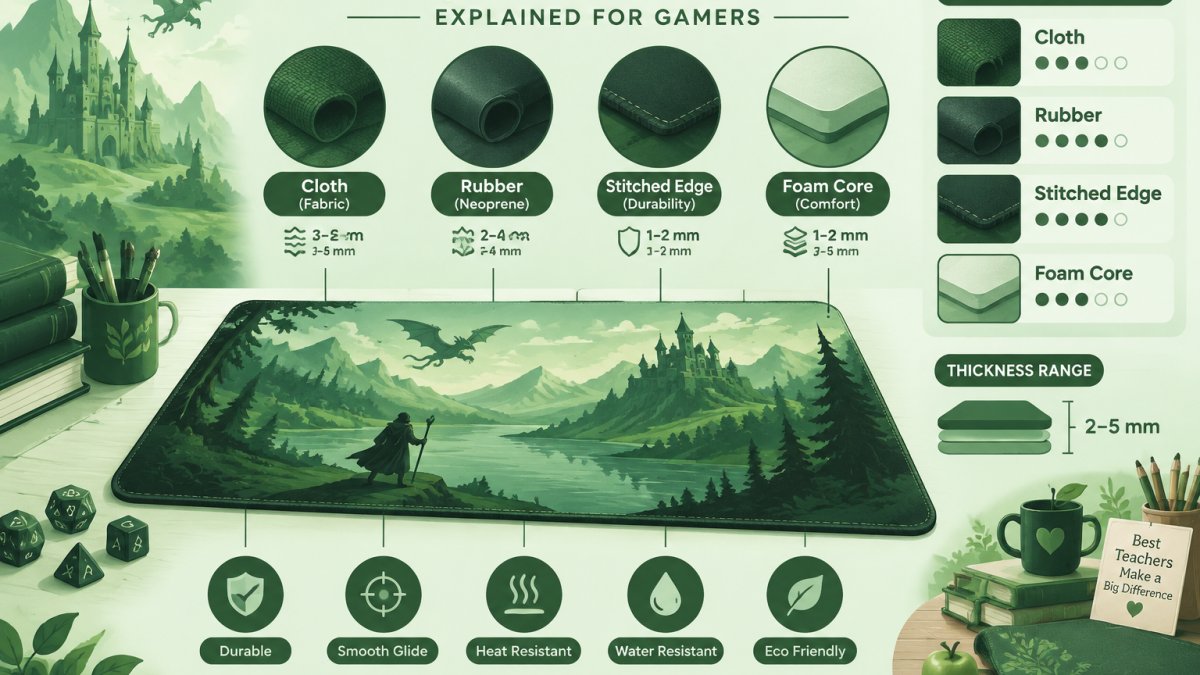
 Ultimate guide
Best Fantasy Desk Mat Materials Explained for Gamers
Last Updated: November 21, 2026
Quick Summary
Cloth is the best all-round material for a fantasy desk mat because fine-weave polyester or Lycra gives smooth mouse glide and takes dye-sublimation print well, while leather and hard surfaces hold artwork as a coating that wears over time. Choose cloth for vivid art and comfort, leather for spill resistance.
- Cloth absorbs spills and collects dust, so it needs regular cleaning.
- A smooth cloth face favors glide speed; a rougher weave adds stopping power for aiming.
- Stitched edges lock layers together and are the main defense against fraying and curling.
- At 2 mm a mat sits nearly flush with the desk but offers little wrist cushion.
- Humidity above roughly 60 percent encourages odor in cloth and can soften stitched-edge adhesive.
Table of Contents
- Why Material Decides Everything on a Fantasy Desk Mat
- The Main Desk Mat Material Types Compared
- Gaming Desk Mat Materials and How They Handle Glide and Control
- Cloth vs Leather Desk Mat: Which Suits Your Table
- How Desk Mat Surface and Base Construction Affect Stability
- Print Quality and Fantasy Artwork on Different Materials
- Fantasy Desk Mat Care, Cleaning, and Long-Term Durability
- Choosing Your Fantasy Desk Mat at Mythikal Sundries
- Frequently Asked Questions
Why Material Decides Everything on a Fantasy Desk Mat
A fantasy desk mat lives a double life. It has to look like a relic pulled from a dungeon hoard and survive forty hours a week of coffee, elbows, and mouse traffic.
This guide breaks down every surface type, how each one handles glide, print, and wear, and which one fits your table. Below, we'll show you exactly how to match artwork ambitions to desk performance, because a gorgeous print on the wrong base becomes a curling, fraying disappointment within months.
Here's what most guides get wrong: they rank materials by feel alone and ignore how a surface holds ink. For a fantasy desk mat, print fidelity is half the purchase.
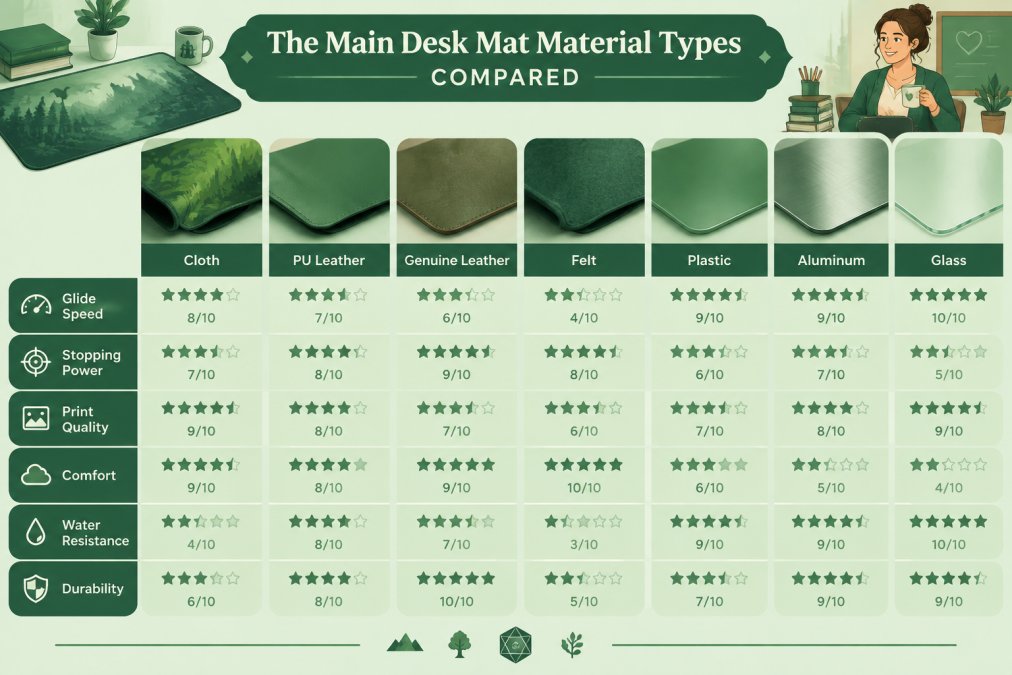
The Main Desk Mat Material Types Compared
Material determines three things at once: how your mouse moves, how long the mat lasts, and how faithfully the artwork reproduces. A desk mat is a large, flat surface layer bonded to a non-slip base, and the top layer does most of the work.
The matrix below scores each common material across the factors that matter most.
Fabric and Cloth Surface Characteristics
Cloth is the default for a reason. A fine-weave polyester or Lycra top gives smooth, consistent mouse glide and takes dye-sublimation print well. The trade-offs: cloth absorbs spills and collects dust, so it needs regular cleaning.
Leather and Synthetic Leather Alternatives
PU leather offers a wipe-clean surface and a sleek look, but printed artwork sits on top rather than soaking in, so fine detail can look flatter. Genuine leather ages beautifully and resists moisture, though it costs more and shows scratches. Neither matches cloth for print vibrancy.
Felt, Plastic, Aluminum, and Glass Options
Felt is warm and quiet but poor for mouse tracking and nearly impossible to print on cleanly. Plastic, aluminum, and glass deliver fast glide and easy cleaning, yet they feel cold, amplify noise, and accept artwork only through surface coating that wears with use.
Gaming Desk Mat Materials and How They Handle Glide and Control
For gaming, surface texture is everything. A smooth cloth face favors glide speed and quick flicks, while a slightly rougher weave adds friction and stopping power for precision aiming. Your mouse feet and optical sensor interact with that texture directly, so a mat that suits one player frustrates another.
Our advice: match the weave to your playstyle, not to a spec sheet. If you want deeper picks for immersive setups, our guide to the best fantasy desk mats for gaming immersion narrows the field further.
Cloth vs Leather Desk Mat: Which Suits Your Table
The cloth vs leather desk mat decision comes down to how you use your desk. Cloth wins for print quality, comfort, and quiet tracking. Leather wins for spill resistance and a premium feel.
- Choose cloth if: you want vivid fantasy art, wrist comfort, and dampened noise.
- Choose leather if: you eat at your desk, want wipe-clean maintenance, and prefer subtle texture over bold print.
- Watch out: cheap PU leather can peel at the edges over time, so check construction quality before buying.
How Desk Mat Surface and Base Construction Affect Stability
A mat is only as good as its base, and the base is where most cheap mats fail first. The underside is usually a natural or synthetic rubber compound, often nitrile rubber or a styrene-butadiene blend, molded into a textured pattern that creates friction against the desk. A plain, smooth backing slides under fast mouse movement; a cross-hatched or dotted texture grips.
Thickness is the second variable. At 2 mm the mat sits nearly flush with the desk, which keeps mouse tracking consistent and lets a keyboard sit level, but it offers little wrist cushion.
Edge construction matters as much as the base. Stitched edges wrap the top fabric around the core and lock the layers together, which is the main defense against fraying and corner curling. Unstitched mats are cut flush and rely on the bond between surface and base; that bond is the first thing to separate after repeated washing or humidity swings.
Flatness out of the box is the third check. A mat that arrives rolled tightly in a narrow tube can retain a memory curl for days. Mats shipped rolled around a wider core, or laid flat in a rigid mailer, tend to relax faster.
Print Quality and Fantasy Artwork on Different Materials
Print fidelity matters when choosing a desk mat. On leather and hard surfaces, artwork is applied as a coating, which can look sharp initially but wears where your wrist and mouse rest.
When you're evaluating artwork, ask whether the design is original. Original mythology artwork holds detail that mass-produced clipart loses. Explore the fantasy collection to see how different designs translate onto printed surfaces.
Fantasy Desk Mat Care, Cleaning, and Long-Term Durability
Care depends on material, and the biggest mistake buyers make is treating every mat like cloth. The table below maps the common surface types to their cleaning method, the stains that actually cause trouble, and the environmental conditions that shorten life.
| Surface | Routine cleaning | Stubborn stains | Main environmental risks |
|---|---|---|---|
| Cloth (polyester, Lycra) | Vacuum weekly; hand-wash with mild soap and cool water | Diluted dish soap for coffee and soda; blot oil with cornstarch first | Humidity and spills feed odor; direct sun fades dye-sublimation ink |
| PU leather | Damp microfiber cloth | Isopropyl alcohol on a cloth for ink; avoid acetone | Heat causes peeling at edges; prolonged sun cracks the coating |
| Genuine leather | Dry cloth; occasional leather conditioner | Saddle soap for grease | Dry air and heat cause cracking; water leaves marks |
| Felt | Vacuum with brush attachment; blot, never rub | Professional cleaning for set stains | Moisture matts the fibers; moths and dust mites |
| Plastic, aluminum, glass | Glass cleaner or damp cloth | Rubbing alcohol for adhesive residue | Scratches from grit; coating wear where wrists rest |
For cloth mats, the print itself is the fragile part. Even so, the highest-wear zone is where your wrist and mouse heel rest, and that zone will show a slight sheen before any color loss appears.
Environmental conditions do more damage than most buyers expect. Humidity above roughly 60 percent encourages odor in cloth and can soften the adhesive bond at stitched edges; a dehumidifier or good airflow helps. Direct sunlight through a window fades dye-sublimation prints over months, not years, so keep the desk out of a sunbeam or use a shade. Heat is the enemy of PU leather in particular, a mat left in a hot car or against a radiator can delaminate at the edges, and that damage is not reversible.
Spills need speed, not scrubbing. Blot liquid with a clean cloth, working from the outside of the spill inward so you do not spread the stain. For coffee or tea on cloth, a drop of mild dish soap in cool water, applied with a cloth and blotted rather than rubbed, lifts most of it.
Watch out: harsh cleaners, bleach, and abrasive pads can strip the print or coating from any surface, and the damage usually shows up as a pale patch exactly where you cleaned.
- Vacuum or shake loose dust weekly
- Spot-clean spills immediately, blotting from the outside in
- Wash cloth mats by hand with mild soap and cool water, never in a machine
- Air-dry flat, away from radiators and direct sun
- Store rolled, not folded, to avoid creases
- Rotate the mat periodically to spread wrist and mouse wear
If a mat underperforms or arrives damaged, review the returns and order issues policy so you know your options.
Choosing Your Fantasy Desk Mat at Mythikal Sundries
Ready to match material to mission? At Mythikal Sundries LLC, we print original fantasy artwork onto functional lifestyle goods. Browse the Mythikal Sundries desk mats to compare designs, and check shipping details so you know when your mat arrives.
The right material turns a desk mat from decoration into gear you rely on every day. If you want original artwork on a surface that performs, Mythikal Sundries LLC offers detailed thematic desk mats with custom print options, durable construction, and designs you won't find on generic marketplaces. Get started with Mythikal Sundries LLC and transform your workspace into something worth adventuring in.
Frequently Asked Questions
What's the best material for a desk mat?
There is no single best material, only the best fit for how you use your desk. Cloth and fabric surfaces give the most reliable mouse tracking and take detailed fantasy artwork well, which is why they dominate gaming setups. PU leather wipes clean easily and suits office use. Felt adds warmth and quiet but traps crumbs. Hard surfaces such as aluminum or glass offer fast glide but show fingerprints. Match the material to your mouse sensor, your cleaning habits, and how much visual detail you want from the print.
Is cloth or leather better for a gaming desk mat?
Cloth wins for most gaming setups. A fine-weave fabric surface gives consistent tracking accuracy for optical sensors and enough friction for stopping power in fast games. Leather and PU leather feel smoother and resist spills, but they offer less control and can feel slick under a quick flick. Choose leather if you mostly work at the desk and want easy cleaning. Choose cloth if mouse glide and precise stopping matter more than wiping down the surface.
Are extended cloth mouse pads good for tabletop gaming?
Yes. An extended cloth pad covers the keyboard and mouse area at once, which keeps dice trays, rulebooks, and character sheets from sliding on a bare desk. The larger surface area also protects the desk from scratches and muffles the sound of dice and tokens. Look for stitched or reinforced edges so the mat does not fray with heavy use, and a rubber or foam base that grips the desk when you lean on it during long sessions.
How do you clean a fantasy desk mat?
Cleaning depends on the material. For cloth mats, spot-clean with mild soap and lukewarm water, scrub gently with a soft brush, and let it air dry flat away from direct heat. Never machine wash a printed cloth mat, since agitation can crack the print and warp the base. PU leather and hard surfaces wipe down with a damp microfiber cloth. Felt needs a lint roller and light vacuuming rather than water. Always check the care label before using any cleaner on a printed fantasy design.
What desk mat material works best for both a keyboard and mouse?
A cloth mat with a rubber base is the safest all-rounder. The fabric surface keeps keyboard feet from slipping and gives the mouse consistent glide across a wide area, while the rubber base holds the whole mat in place. If you want a single extended mat under both, look for a fine-weave cloth with stitched edges so it sits flat.
Will a printed fantasy design wear off over time?
Print longevity depends on the material and how the mat is made. Keep the mat out of direct sunlight and clean spills promptly to help extend its life. Keep the mat out of direct sunlight and clean spills promptly to extend print life. Ask the seller how the artwork is applied before ordering, especially for detailed mythology artwork where color accuracy matters.