 blog
Best Desk Mats for Tabletop Gaming: 16x32 Fantasy Mats
Table of Contents
- Why 16x9 Desk Mats Beat Standard Mousepads for Tabletop Gaming
- Quick Comparison: What to Look For in a Tabletop Gaming Mat
- The Best Desk Mat Material for Dice Rolling and Card Picking
- How to Clean Gaming Desk Mats Without Damaging the Artwork
- Custom Fantasy Desk Mats: Artwork, Sizing, and Personalization
- Thickness, Ergonomics, and Accessory Compatibility
- Conclusion
- Frequently Asked Questions
Last Updated: September 27, 2026
Why 16x9 Desk Mats Beat Standard Mousepads for Tabletop Gaming
A 16x9 desk mat gives you one continuous surface for your keyboard, mouse, dice tray, and character sheet, handy because tabletop play is messy, with rolling, card picking, miniature sliding, and drink reaching all happening in the same square meter of desk.
Desk Coverage vs. Mouse-Only Space
Coverage is the whole argument. A mousepad protects one zone. A 16x9 mat protects the desk itself from spilled drinks, scratched dice, and the slow abrasion of a thousand card shuffles.
Dice, Cards, and Miniatures Need Different Surfaces
Dice want enough give to absorb impact and enough texture to stop a wild roll. Cards want low friction so a fingernail can lift a corner without bending it. Miniatures want a stable, flat plane that will not tip a painted figure.
Quick Comparison: What to Look For in a Tabletop Gaming Mat
Use this table as a shorthand before the deeper sections. It maps each decision to the spec that drives it.
What you care about | Spec to check | Why it matters |
|---|---|---|
Card picking | Surface friction | Low friction lifts corners cleanly |
Dice control | Material and thickness | Foam-backed cloth absorbs bounce |
Mouse accuracy | Surface texture | Consistent weave keeps tracking steady |
Longevity | Stitched edges | Prevents fraying and peeling |
Cleanup | Water resistance | Spills wipe instead of soak |
Comfort | Mat thickness | Cushions wrists during long sessions |
The Best Desk Mat Material for Dice Rolling and Card Picking
Cloth over a rubber base is the best all-around material for tabletop gaming because it balances dice control, card handling, and mouse glide. Neoprene adds cushioning and water resistance; hard surfaces offer the smoothest glide but the least forgiveness for dice. Each behaves differently under the three actions players repeat most: rolling dice, lifting cards, and nudging miniatures.
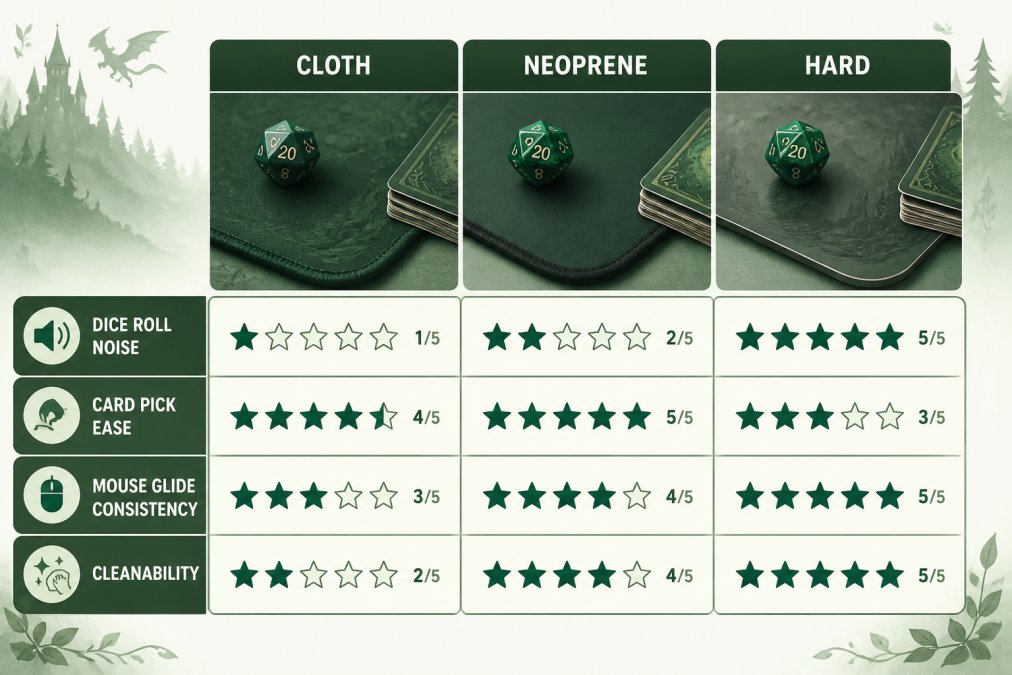
Cloth, Neoprene, and Hard Surfaces Compared
Cloth mats use a woven fabric top bonded to a non-slip rubber base. The weave gives dice something to bite into, so rolls settle instead of skittering, and cards lift easily because the fabric has just enough texture without grabbing. A medium weave is the sweet spot: tight enough that a d6 stops within a few inches, open enough that a fingernail can catch a card corner without bending it.
Surface Friction and Tactile Feedback
Friction is not a flaw to eliminate. It is a dial you set to match your play style.
Action | Cloth | Neoprene | Hard |
|---|---|---|---|
Dice roll noise | Moderate | Quietest | Loudest |
Dice bounce distance | Short | Shortest | Longest |
Card pick ease | Easy | Moderate | Slippery |
Miniature stability | Good | Good | Slick |
Mouse glide | Consistent | Slightly draggy | Fastest |
Spill resistance | Low | High | High |
Cleanup effort | Moderate | Low | Lowest |
Matching Material to Your Table's Mix
Most tables are a mix, and the mix changes week to week. A few common patterns:
- Card-heavy groups (deck-builders, trading card games): a tighter weave reduces the chance of a card sliding off the play area when someone reaches across the table.
- Dice-heavy groups (roleplaying games, war games): a slightly thicker cloth or neoprene top absorbs the clatter and keeps dice from rolling under the couch.
- Miniature-heavy groups (skirmish games, dungeon crawlers): a firm, flat surface with a shallow weave keeps bases from catching and tipping a painted figure.
- Mixed groups: a medium-weave cloth mat is the compromise that disappoints no one and delights no one, usually the right call.
What About Acrylic Tokens and Metal Coins?
Accessory compatibility is where material choice gets subtle. Acrylic tokens slide easily on hard mats and can scratch on coarse weaves; metal coins feel satisfying on cloth but can leave faint marks on neoprene over time. If your game uses lots of small tokens, a medium weave with a slightly cushioned base keeps them from skating when someone bumps the edge.
How to Clean Gaming Desk Mats Without Damaging the Artwork
Most cloth and neoprene gaming mats clean up with lukewarm water, a drop of mild dish soap, and a soft cloth. The artwork sits in or under the surface layer, so the real risk is abrasion and heat, not water.
Follow this routine:
- Brush off crumbs and dice dust with a dry microfiber cloth
- Mix lukewarm water with one drop of mild dish soap
- Wipe in gentle circles, working from the center outward
- Avoid scrubbing stitched edges with a stiff brush
- Rinse the cloth, not the mat, and wipe again with clean water
- Lay the mat flat to air dry, away from direct sun and heaters
- Never machine wash, tumble dry, or iron a printed mat
Custom Fantasy Desk Mats: Artwork, Sizing, and Personalization
Custom fantasy desk mats let you choose the artwork, dimensions, and often the finish, so the mat fits your desk and your campaign rather than the other way around. At Mythikal Sundries TM, every mat starts from original artwork and customization is available at quoted prices.
Original Art vs. Generic Fantasy Designs
The difference shows up over months, not minutes. Generic designs repeat across storefronts, so two players at the same table can end up with identical mats. Original artwork gives you a piece tied to a specific scene, character, or mood.
Thickness, Ergonomics, and Accessory Compatibility
A 3 mm mat is the common middle ground: enough cushion to soften wrist pressure, thin enough to keep a keyboard stable. Thicker mats around 4 to 5 mm add comfort for long sessions but can make a low-profile keyboard feel spongy. What most guides skip is how thickness changes the way your wrist, your dice, and your accessories behave over a three-hour game night.
How Thickness Affects Wrist Strain
Ergonomics matter more than most buyers expect. A mat that lifts your wrist a few millimeters can reduce the angle your hand holds during hours of play, small per minute, large per session.
- 2 mm and under: minimal cushion. Fine for a keyboard-and-mouse setup where your wrist rarely rests on the mat, but card shuffling and dice retrieval start to feel hard on the heel of your hand after an hour.
- 3 mm: the most common thickness. Enough give to soften the edge of a desk against your wrist, thin enough that a keyboard does not wobble. Most players find this comfortable for sessions up to about two hours.
- 4 to 5 mm: noticeably plusher. Good for players who lean on the mat while reaching across the table, but a low-profile keyboard can feel like it is sitting on a sponge. If you use a wrist rest, measure it against the mat thickness so the two do not fight each other.
- 6 mm and up: rare for desk mats and usually too soft for stable dice rolls. The mat compresses under a die and can cause unpredictable bounces.
Dice, Cards, and Miniatures by Thickness
Thickness changes how the surface behaves, not just how it feels.
- Dice: a thicker mat absorbs more impact and reduces bounce, but past about 5 mm the surface compresses unevenly and rolls become less predictable. A 3 to 4 mm mat is the usual sweet spot for dice control.
- Cards: thickness matters less for picking than weave does, but a very soft mat can make a card feel like it is sinking when you press a fingernail under the corner. A firmer 3 mm mat keeps cards sitting on top of the surface.
- Miniatures: a thicker mat can actually help here. The slight give keeps a base from sliding when the table is bumped, and a dropped figure has a softer landing. Just avoid deep textures that can catch on a base edge.
Accessory Compatibility Checklist
Accessory compatibility is the quiet dealbreaker. Check these before buying:
- Mouse feet and skates: smoother feet pair better with cloth than with coarse weaves. On a 5 mm mat, a heavy mouse can sink slightly and feel draggy.
- Dice trays: a rigid tray sits fine on any mat. A soft tray needs a firm base beneath it, or it will not sit flat on a thick mat.
- Miniature terrain: textured surfaces can catch on deep weaves. Resin terrain with sharp edges can also snag a loose weave over time.
- Monitor stands and clamps: measure clearance if the mat runs underneath. A 5 mm mat can push a clamp past its adjustment range.
- Drinkware: a water-resistant top saves you from a knocked-over mug. On a thick mat, a spill can pool in the cushion before you notice it.
- Card sleeves: matte sleeves glide differently than glossy ones. If your group uses matte sleeves, a slightly tighter weave gives better control.
Breaking In a New Mat
If you are coming from a bare desk or a thin mousepad, expect the first week to feel different. The extra cushion changes how your wrist rests, and most players adjust within a few sessions. A new cloth mat may shed a little fiber at first; a quick wipe with a dry microfiber cloth handles it.
Conclusion
Choosing among the best desk mats for tabletop gaming comes down to matching surface, size, and thickness to how you actually play. Get the material right and everything else, artwork included, becomes a pleasure rather than a compromise.
Frequently Asked Questions
What size desk mat is best for tabletop gaming?
A 16x32 extended desk mat covers the sweet spot for most tabletop setups. It provides enough surface area for a character sheet, dice tray, and card piles while still leaving room for a mouse and keyboard. Standard mousepads only cover 8x10 inches, which forces you to roll dice on bare table and risk scratching the surface. Measure your table space first, then pick a mat that fills it without overhang.
Are 16x32 desk mats better for board games than standard mousepads?
Yes, by a wide margin. Standard mousepads are built for optical sensor tracking, not card picking or dice rolling. A 16x9 desk mat gives you a larger surface area with stitched edges that resist fraying, plus a non-slip rubber base that keeps the mat flat when you slide cards or roll heavy dice. The extended coverage also protects your table from spills and scratches during long sessions.
What materials are most durable for tabletop gaming mats?
Cloth-topped mats with stitched edges and a rubber base hold up best for tabletop use. The cloth surface handles dice rolls without bouncing, and stitched edges prevent peeling after repeated cleaning. Neoprene adds water resistance and cushioning for wrist support during long games. Hard surfaces offer the most precise mouse glide but can be loud when dice hit them and may wear down miniature bases faster.
Can I get custom-sized desk mats for my tabletop setup?
Many providers, including Mythikal Sundries TM offer custom sizing and personalization. You can request specific dimensions to fit odd-shaped tables or custom artwork that matches your campaign setting. Customization pricing depends on size, material, and artwork complexity, so reach out for a quote. A custom fantasy desk mat with original art makes your game table feel like part of the story rather than a generic accessory.